

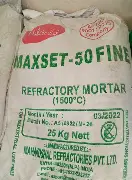

Refractory Mortar for High-Temperature Brick Lining and Furnace Applications
Refractory Mortar securely bonds refractory bricks in high-temperature industrial applications. At Pamon Ventures Ltd, we supply high-quality Refractory Mortar across Kenya, Uganda, and Tanzania to support cement plants, steel industries, power plants, glass factories, and other heavy industrial operations.
Manufacturers formulate Refractory Mortar using high-alumina, silica, or fireclay materials to match different refractory brick types. This composition allows the mortar to withstand extreme heat while maintaining strong adhesion between bricks. It prevents gas leakage, improves structural stability, and enhances overall furnace performance.
Technicians apply Refractory Mortar during brick installation to create tight, heat-resistant joints. The mortar expands and contracts with temperature changes, reducing cracking and joint failure. It resists chemical attack, thermal shock, and abrasion, ensuring long-term durability under harsh operating conditions.
Refractory Mortars improves lining integrity and extends furnace service life. By sealing joints properly, it reduces heat loss and increases energy efficiency. Industries rely on it to maintain safe, stable, and efficient high-temperature operations.
Key Features of Refractory Mortar
• Withstands high temperatures up to 1600°C depending on grade.
• Provides strong adhesion between refractory bricks.
• Resists thermal shock and cracking.
• Seals joints to prevent gas and heat leakage.
• Matches different brick compositions (alumina, silica, fireclay).
• Improves furnace stability and durability.
Applications of Refractory Mortar
• Cement kiln brick installation.
• Steel furnace and ladle lining.
• Glass furnace construction.
• Boiler and incinerator lining.
• Industrial chimney and flue systems.
Refractory Mortar strengthens furnace structures, protects joints, and ensures long-lasting performance in high-temperature environments.
Frequently Asked Questions (FAQs)
What are Refractory Mortars used for.
It bonds refractory bricks and seals joints in high-temperature furnaces and kilns.
Can I use normal cement instead.
No. Ordinary cement cannot withstand high temperatures and will fail quickly.
How do technicians apply Refractory Mortars.
They mix it with water (if dry type), apply it between bricks, and allow proper curing before heating.
Does it resist chemical attack.
Yes. It resists heat, slag, and chemical exposure depending on the selected grade.
Should the mortars match the brick type.
Yes. Matching mortars to brick composition ensures better bonding and thermal compatibility.
Location and Contact
Pamon Ventures Ltd
Industrial Area, Nairobi
Email: [email protected]
Call: +254 721 914474
WhatsApp: +254 724 894263
We supply Refractory Mortars and complete high-temperature lining solutions across Kenya, Uganda, and Tanzania.




Reviews
There are no reviews yet.